
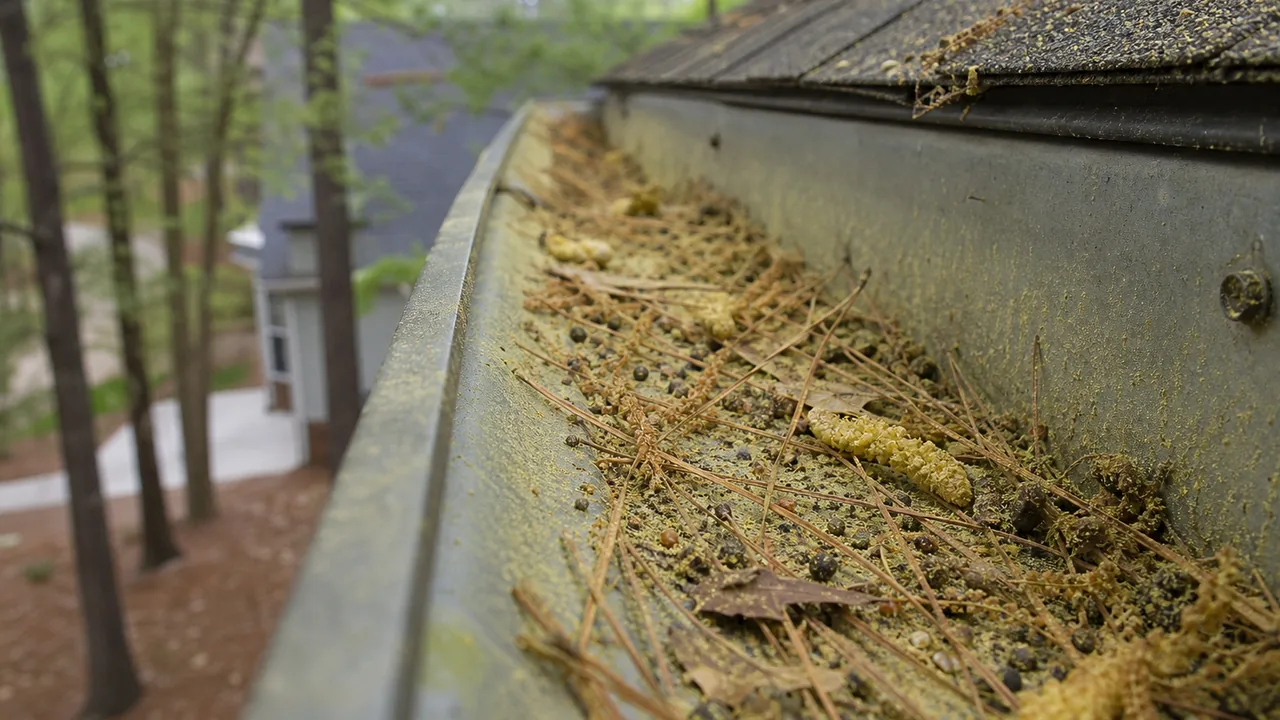
Every spring, Cary homeowners watch their cars, driveways, and porches turn yellow. That same pine pollen is also landing in gutters — and unlike leaves, it does not just sit there. It combines with moisture to form a dense, paste-like crust that blocks water entry and is nearly impossible for rain to clear on its own.
If you have micro-mesh gutter guards, pine pollen is often the primary reason they stop working. The pollen particles are small enough to land on the guard surface, mix with fine roof grit, and form a film that prevents water from passing through the mesh at all.
What pine pollen does to gutters
Pine pollen season in Cary typically runs from late March through May, peaking in April. During peak weeks, pollen accumulation in gutters can be significant — especially under large loblolly or longleaf pines, which are common throughout Cary neighborhoods like Amberly, Preston, and Carpenter Village.
When pollen mixes with morning dew, light rain, and organic debris, it binds together into a dense mat. Once that mat dries, it hardens across the gutter surface and blocks even moderate water flow. The result is overflow that looks like a clog but feels random — because the gutter was cleared of leaves and still does not drain.
Why regular cleanings miss it
Standard gutter cleaning removes leaves, sticks, and loose debris. Pollen crust requires scrubbing or brushing, not just blowing out or scooping. If your cleaner is not specifically addressing the guard surface or the top layer of buildup, pollen residue stays in place and rebuilds faster the following spring.
Neighborhoods most affected
Homes with significant pine tree coverage near lot lines, common areas, or street trees accumulate pollen faster. In Cary, neighborhoods like Amberly (western Cary, high pine density), Lochmere (wooded buffers), and Preston (mature canopy) tend to see the heaviest pollen loads each spring.
What to do
Schedule a spring cleaning specifically after peak pollen season — typically mid to late May in Cary — rather than before it. Cleaning before the pollen season ends means the buildup will restart immediately after service. If you have micro-mesh gutter guards, confirm your cleaner brushes the guard surface rather than just flushing the gutter below.
For homes near heavy pine coverage, a dedicated gutter guard cleaning visit in May and a standard debris cleaning in late fall is often the most effective schedule.
Signs pollen has clogged your gutters
- Water sheets off the roofline during rain instead of entering the gutter
- Gutters look clean from the ground but overflow during rain
- Yellow-green film visible on guard surfaces or gutter edges
- Gutter guards were installed but stopped working in spring
Call Cary Gutter Pros to schedule a post-pollen spring cleaning — we confirm drainage on every outlet before leaving the property.